

Corporate events are no longer just formal gatherings. Today, companies focus on building connection, collaboration, and motivation among employees, and one of the best ways to accomplish this is through organizing games for corporate events. When thoughtfully planned, these activities energize participants, encourage teamwork, and create memorable shared experiences. From strategy challenges to creative tasks and physical adventures, the right mix of fun games for corporate events can transform any corporate gathering into something impactful and engaging.
This curated list includes 25 fun corporate team-building activities. These include indoor games, board games, puzzle games, and several group challenges designed to boost morale and teamwork, all suitable for corporate events.
Participants: 12 to 600+
Time Required: 120 to 180 minutes
Description:
In this high engagement activity, teams are presented with a simulated business or financial challenge, a “million dollar scenario.” Teams must strategize, allocate simulated resources, negotiate deals or tradeoffs, make decisions under pressure, and collaborate to maximize returns. It may involve rounds of negotiation, role playing, budget management, and quick team discussions.
How it helps:
The Million Dollar Challenge forces teams to think strategically, prioritize tasks, negotiate, and manage limited resources, much like in real business situations. It sharpens decision-making, financial awareness, leadership under pressure, and collaboration across diverse roles. It also reveals who takes initiative, who leads, who supports, and how well the group communicates under time and resource constraints.
Participants: 24 to 300+
Time Required: 150 to 180 minutes
Description:
A blended treasure hunt and competitive event. Teams navigate through clues or challenges, possibly using maps or tech tools, find checkpoints or solve puzzles, and race against other teams to complete the hunt. The Olympics twist adds a competitive spirit, perhaps points for speed, creativity, accuracy, or bonus tasks.
How it helps:
This Geo Hunt activity builds cooperation, strategic planning, problem-solving, and healthy competition. It encourages teams to communicate, delegate, think on their feet, and coordinate under time pressure. The hunt format also makes the event exciting and engaging, boosting team energy and morale while improving group cohesion and trust.
Participants: 24 to 600+
Time Required: 90 to 120 minutes
Description:
Teams face a simulated survival challenge as if climbing or surviving conditions like a mountain expedition. They may confront tasks that test endurance, collaborative decision making, resource management, role assignment, and crisis handling. The scenarios are like time constraints, unexpected obstacles, and require careful teamwork to reach the summit.
How it helps:
Mount Everest Challenge builds resilience, collective problem-solving, leadership under stress, mutual trust, and clarity in roles. It helps participants understand the importance of planning, coordination, supporting each other, and adapting rapidly to changing conditions, skills that map well to real-world corporate crises or high-pressure projects.
Participants: 8 to 50
Time Required: 120 to 150 minutes
Description:
Teams invent their own board game. They conceptualize rules, design the board or gameplay, define roles, and simulate a playthrough. This involves creativity, negotiation, and cooperation as team members debate rules, manage balance, and ensure the game is fun and fair.
How it helps:
This Next Big Board Game exercise stimulates creativity, collaboration, shared ownership, and inclusive decision-making. It also encourages participants to think from multiple perspectives, such as designer, player, and rule maker. It is excellent for innovation, teamwork, and breaking down hierarchical barriers as everyone contributes ideas equally.
Participants: 40 to 500+
Time Required: 90 to 120 minutes
Description:
In this simulation, teams represent different stakeholders or parties in a business scenario, such as clients, stakeholders, or vendors. Through negotiation, resource allocation, and decision making, they aim to reach mutually beneficial win-win outcomes. The process includes rounds of bargaining, proposals, discussions, and collaborative planning.
How it helps:
Tough Deal enhances negotiation skills, empathy, communication, and strategic thinking. It simulates real-world corporate interactions and helps participants practice collaboration even in conflict or competition scenarios, learning to aim for win-win rather than win-lose, a valuable leadership and teamwork lesson.
Participants: 20 to 200
Time Required: 75 to 90 minutes
Description:
Teams create a short performance, such as a skit, a short film, or a dramatic presentation, around a theme or challenge provided by facilitators. They plan, assign roles such as director, actors, props, or script writers, rehearse, and then perform in front of peers.
How it helps:
Lights, Camera, Action activity builds creativity, communication, collaboration, and confidence. It helps break social barriers, encourages expression, and fosters empathy. Employees learn to trust each other, coordinate under time pressure, and appreciate different roles and talents, enhancing team cohesion and respect.
Participants: 24 to 500+
Time Required: 90 to 120 minutes
Description:
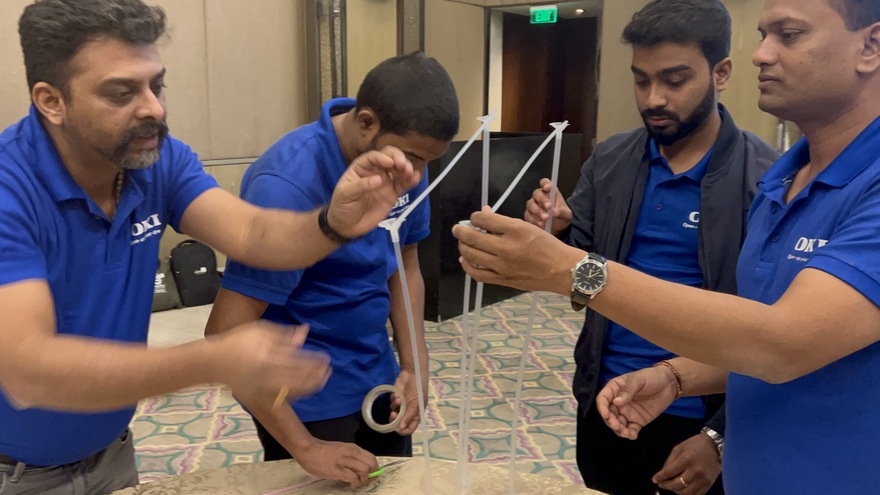
Teams are tasked with conceptualizing, planning, and constructing, using available materials or simulated resources, a tower or high-rise project. They must assign roles, manage resources, coordinate phases, and ensure structural or simulation requirements are met. The challenge is both technical and collaborative.
How it helps:
The Building the Burj builds project management skills, planning, resource allocation, leadership, and teamwork. It mirrors real corporate projects where coordination, timing, and collective effort matter. Participants learn accountability, communication, delegation, and the importance of each team member’s role.

Participants: 12 to 600+
Time Required: 120 to 180 minutes
Description:
In this activity, teams design and build a chain reaction, a series of interlinked steps where one action triggers another, leading to a final result. It could involve physical components, puzzles, tasks, or symbolic reaction steps. Teams must coordinate carefully to ensure each segment links properly to the next.
How it helps:
Chain Reaction Challenge fosters careful planning, coordination, trust, patience, and collaboration. It shows how each individual’s contribution affects the larger outcome and how timing and coordination are vital. It strengthens collective responsibility and clarifies interdependence among team members.
Participants: 24 to 300+
Time Required: 120 to 180 minutes
Description:
Teams engage in a treasure hunt-style activity with clues, challenges, or tasks that lead toward a gold or a goal. It may combine physical movement, puzzles, coordinated tasks, and deadlines.
How it helps:
The Gold Rush activity builds exploration, problem-solving, motivation, teamwork, and healthy competition. It reinforces goal orientation, shared focus, strategic thinking, and collective reward sensation, boosting morale and collaboration.
Participants: 8 to 50
Time Required: 150 minutes
Description:
Meri Awaaz Sunoo is a communication-focused activity where messages or instructions get passed in a cascade, like Chinese whispers, but structured creatively. Participants engage in tasks requiring precise communication across individuals or sub-teams. The emphasis is on clarity, listening skills, and how messages transform across layers.
How it helps:
Helps improve communication clarity, active listening, trust, attention to detail, and awareness of miscommunication risks. It underscores how important clear messaging is in a corporate environment and fosters empathy by showing how messages can be distorted if not conveyed properly.
Participants: 10 to 200
Time Required: 30 to 45 minutes
Description:
This is an interactive quiz-style challenge that blends company knowledge, general trivia, and fun themed categories into a fast-moving competition. Teams use buzzers or digital quiz tools to answer questions spanning workplace facts, company culture, pop culture, industry trends, and surprising miscellaneous topics. The game creates a lively atmosphere where team members debate answers, strategize on when to buzz in, and cheer each other on.
How it helps:
Office Trivia Challenge boosts recall, group communication, and quick thinking. It strengthens team spirit as employees rally around shared knowledge and celebrate collective wins. It is especially effective for new teams because it introduces company facts in a fun and memorable way. Trivia also levels the playing field, allowing introverts, thinkers, and analytical personalities to shine.
Participants: 20 to 300
Time Required: 20 to 30 minutes
Description:
Human Bingo is a highly interactive mixer where participants receive bingo cards filled with personal characteristics, experiences, or hobbies, such as having traveled abroad, owning a pet, or speaking more than two languages. Employees move around the room, meeting colleagues and asking questions to match the prompts. Every connection helps them mark off squares, pushing them toward completing lines or full cards. Laughter, curiosity, and conversation naturally occur as employees discover unexpected facts about one another.
How it helps:
This activity encourages mingling, breaks social barriers, and builds rapport among participants who may not interact regularly. It promotes communication, openness, and a sense of inclusion. Human Bingo is ideal for large crowds or events where employees from multiple departments need a simple way to get to know one another quickly.
Participants: 10 to 100
Time Required: 40 to 60 minutes
Description:
This fast-paced indoor scavenger hunt transforms the office or event space into an adventure zone filled with clues, riddles, and timed missions. Teams receive challenge lists that may include photo tasks, object retrieval, decoding puzzles, solving riddles, or recreating scenarios using available materials. With time ticking, employees must divide tasks, run coordinated searches, and solve clues while avoiding dead ends. The environment becomes lively as teams race from station to station, completing missions.
How it helps:
Scavenger Dash promotes teamwork, time management, and creative problem-solving. It encourages teams to strategize quickly, assign roles effectively, and communicate under pressure. It energizes participants and is a perfect indoor game for corporate events when outdoor activities are not feasible.
Participants: 15 to 80
Time Required: 45 to 75 minutes
Description:
Teams receive everyday materials such as cardboard, plastic sheets, tape, pipes, or foam, and are tasked with building a small boat capable of floating or holding weight. The challenge may include design constraints, buoyancy tests, or competitive races where completed boats undergo floating trials. The task forces teams to conceptualize a structure, test prototypes, and refine their designs before the big test.
How it helps:
Build the Boat develops engineering thinking, creativity, and collaborative design. Teams learn to combine individual strengths, test assumptions, and iterate under time limitations. The floating test adds excitement while offering a clear lesson on functionality, innovation, and teamwork.

Participants: 8 to 60
Time Required: 30 to 50 minutes
Description:
Puzzle Masters Relay is a multi-stage challenge where teams compete to solve a sequence of puzzle games for corporate events. Examples include logic puzzles, jigsaws, cipher decoding, tangram assembly, or hidden message challenges. Each puzzle completed unlocks the next stage, creating a relay-like progression. Teams must divide intellectual tasks based on strengths and ensure accuracy to avoid penalties.
How it helps:
This activity enhances analytical thinking, patience, and collaboration. It emphasizes collective intelligence, demonstrating how diverse perspectives lead to faster problem-solving. Ideal for teams with strategic roles or analytical job functions.
Participants: 20 to 300
Time Required: 60 to 90 minutes
Description:
Office Olympics transforms everyday office items into playful competition tools. Potential events include chair rolling races, stapler toss, rubber band archery, or desk chair relays. Participants form teams and compete in multiple rounds, earning points toward a medal ceremony. The atmosphere becomes festive, filled with cheering, spontaneity, and friendly rivalry.
How it helps:
Office Olympics boosts energy, camaraderie, and team bonding. It allows employees to let loose, participate in physical movement, and enjoy fun interactions outside formal settings. It helps reduce stress and brings laughter to high-pressure teams.
Participants: 15 to 150
Time Required: 30 to 45 minutes
Description:
Teams must design protective structures using limited materials such as straws, paper, tape or cotton to prevent an egg from breaking when dropped from a height. Teams brainstorm, sketch designs, test prototypes, and refine their ideas before the final drop test. The suspense of witnessing each contraption withstand or fail the drop adds excitement.
How it helps:
This activity builds creativity, engineering reasoning, and collaborative planning. It encourages experimentation and risk-taking. Teams learn valuable lessons in problem-solving with constraints and learn how collective input leads to better design outcomes.
Participants: 10 to 200
Time Required: 30 to 60 minutes
Description:
Adapted from the popular TV format, teams compete in a series of fast and humorous challenges that must be completed within 60 seconds. Tasks may include cup stacking, balloon balancing, ping pong bouncing, or precision coordination games. The rapid movement between stations keeps energy levels high and participants fully engaged.
How it helps:
Minute to Win It builds agility, concentration, and team motivation. It is an ideal energizer for long meetings or workshops because it injects humor and excitement into the atmosphere. Everyone gets a chance to participate regardless of fitness level.
Participants: 10 to 150
Time Required: 45 to 90 minutes
Description:
Teams or individuals step onto the stage to perform selected songs while colleagues cheer them on. Performances may include themed rounds, duet challenges, or group singing. The atmosphere is lively and filled with laughter as participants showcase hidden talents or creative dramatics.
How it helps:
Corporate Karaoke builds confidence, expression, and vulnerability in a supportive environment. It helps break hierarchical barriers and encourages team members to appreciate different personalities within the group. It is a great social bonding activity.
Participants: 10 to 80
Time Required: 30 to 60 minutes
Description:
Teams receive Lego kits and a theme such as building a futuristic city, recreating a landmark or designing a functional structure. They must plan, allocate mini-roles, and build within the set timeframe. Facilitators may include bonus conditions or prompt story-based presentations for added creativity.
How it helps:
This challenge promotes innovation, planning, and imaginative thinking. It is especially effective as a creative board game for corporate events that encourages storytelling and teamwork. Teams also learn how small parts can contribute to a cohesive final structure.
Participants: 10 to 150
Time Required: ~30 to 45 minutes
Description:
Teams are given a sealed mystery box filled with unrelated items such as strings, plastic objects, cloth pieces, bottles, or tools. Their task is to create something functional, artistic or themed using only the items provided. Teams must brainstorm, assign roles, and work rapidly as the clock counts down.
How it helps:
Mystery Box Challenge encourages creativity, resourcefulness, and adaptive thinking. It teaches participants to innovate within constraints and demonstrates the power of divergent thinking. It works especially well for product design or marketing teams.
Participants: 8 to 100
Time Required: 15 to 20 minutes
Description:
In this quiet but powerful activity, participants must arrange themselves in a line based on specific criteria such as birthday, years of experience, or alphabetical order. However, they are not allowed to speak. They must use gestures, eye contact, and reasoning to determine their positions and complete the line accurately.
How it helps:
The Silent Line Up improves nonverbal communication, observation, and teamwork. It shows the value of clarity and patience. It is a great way for teams to build cohesion without relying on typical verbal instructions.
Participants: 10 to 80
Time Required: 30 to 60 minutes
Description:
Participants sample a curated selection of wines or coffees and attempt to identify flavors, origins, or aroma notes. Teams may discuss their observations, compare tasting notes, and engage in blind tasting rounds. Facilitators may introduce scoring cards or themed tasting challenges.
How it helps:
This activity builds sensory awareness, attention to detail, and open discussion. It encourages participants to slow down, engage their senses, and enjoy a more relaxed form of team bonding.
Participants: 8 to 60
Time Required: 20 to 30 minutes
Description:
Participants sit in a circle and create a story together, one sentence at a time. Each person must listen carefully and add a sentence that aligns with the direction of the narrative. Themes can be humorous, mysterious, or work-relevant. As the story evolves, unexpected twists emerge.
How it helps:
Story Chain improves listening, creativity, and flow-based collaboration. It highlights how collective creativity emerges when everyone contributes. It also strengthens verbal communication and imagination.
Participants: 20 to 300
Time Required: 45 to 90 minutes
Description:
Teams receive art supplies and a large canvas or set of panels to create a shared mural. The mural may represent company values, event themes or creative interpretations. Teams must coordinate colors, layout, and concepts to ensure their individual sections align with the complete artwork.
How it helps:
This activity builds unity, creativity, and visual communication. It empowers employees to express themselves and collaborate on something meaningful. The final mural serves as a lasting reminder of teamwork and shared achievement.
Incorporating fun and engaging games into corporate events transforms routine gatherings into powerful team-building experiences. These activities not only energize participants but also encourage communication, collaboration, and creative problem-solving, skills that directly translate to improved workplace performance. Whether the goal is to break the ice, boost morale, foster innovation, or strengthen interdepartmental relationships, the right mix of games can significantly enhance the overall impact of any corporate event.
From strategic simulations and creative challenges to high-energy competitions and relaxed social activities, the 25 games highlighted above offer something for every team dynamic and event objective. By selecting activities that resonate with participants and align with organizational goals, companies can create memorable experiences that reinforce teamwork, build trust, and cultivate a positive work culture. Ultimately, well-designed corporate games don’t just provide entertainment, they lay the foundation for stronger, more connected, and more motivated teams.