

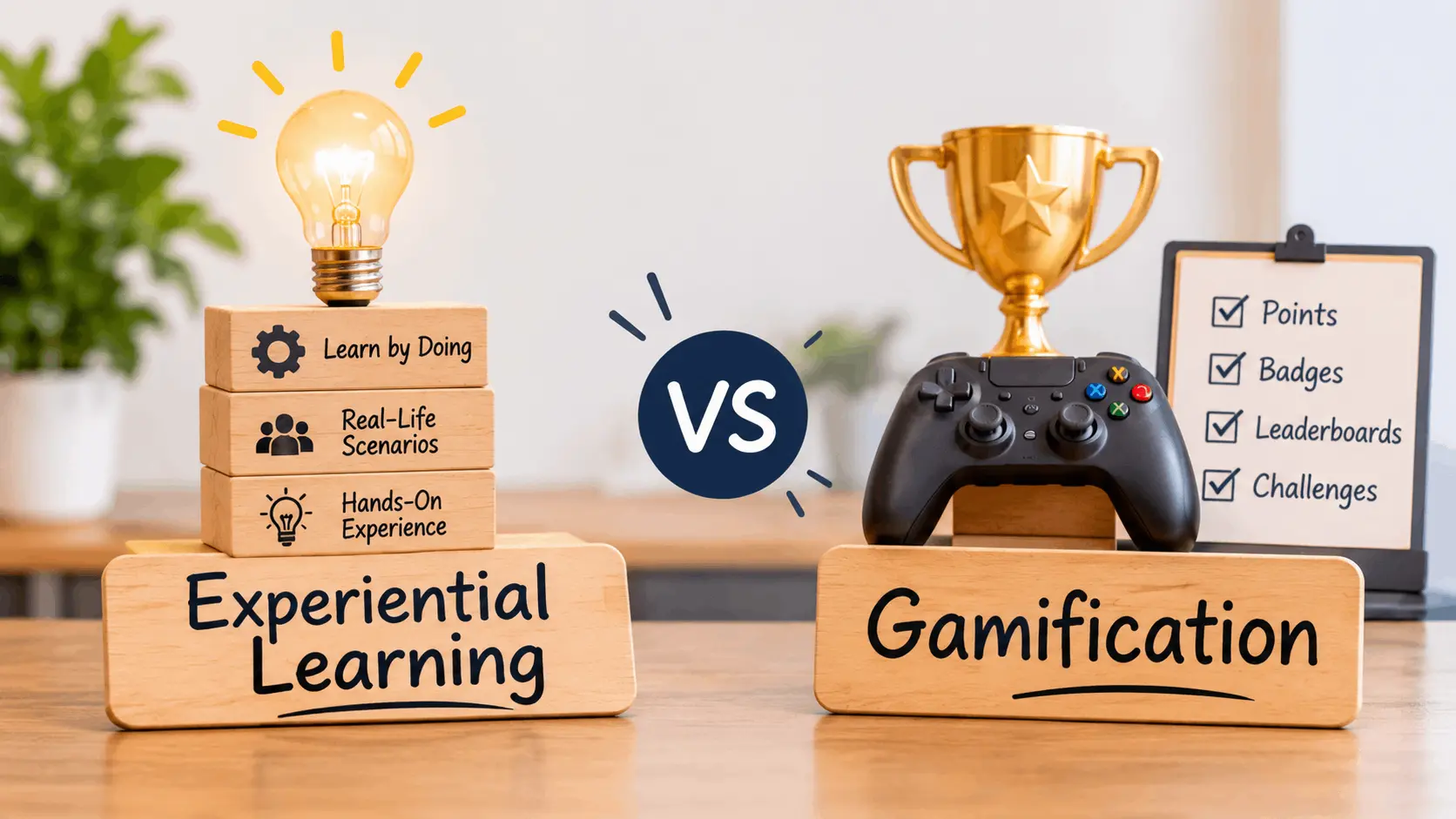
The major difference between gamification and experiential learning is that on the one hand, business entities may encourage employee engagement, collaboration and workplace performance through the implementation of gamification. Learning by doing, reflection and application are considered in experiential learning, and game attributes like points, rewards and challenges are applied and used to motivate employees using gamification. The two methods have the potential to enhance corporate training by making it more interactive and effective when they are geared towards organizational objectives.
Corporate training is taking the form of lectures and presentations. Companies need staff capable of communicating, troubleshooting and making informed choices, and liaising with other staff. Therefore, organizations are increasingly considering interactive ways of developing their employees.
Experiential and gamification are two popular techniques. They are having the same goal even though they are in favor of leading participation. Experiential learning will help to train employees using learning by doing as well as gamification will introduce the game mechanics in training to make it more interesting.
This knowledge of the distinction between experiential learning and gamification will assist HR professionals, learning and development managers and business leaders to select a suitable model to implement on their employees. Regardless of the purpose of the training, be it leadership development or team building, or improved decision-making, selecting the correct training method could really count.
Gamification in team building involves incorporating game elements into corporate activities to encourage participation, motivation, and collaboration. These elements may include points, badges, rewards, leaderboards, time limits, and team-based challenges. Common examples of gamification in corporate training India include:
Corporate training can be more fun and not a boring task with the help of gamification. It also helps in engaging employees instead of just listening to an instructor.
Making points or getting into a competition will not necessarily bring about any meaningful learning though. Gamified activities in companies need to be tied in with particular learning objectives and feedback needs to be delivered so that it allows the employees to know what they can do to improve.
Experiential learning as a training method allows employees to acquire knowledge through actual experience, contemplation, and practice. Rather than merely talking about challenges in the workplace, the participants will be involved in activities that can help them to make use of the relevant skills.
An example can be related to a business simulation, where employees are given a small budget to use and with which they have to distribute resources and make strategical decisions in a company simulation. Following the activity, participants talk about their decisions, analyze the results and find out what they can learn to apply in their real jobs.
The strategy links hands-on experience with reflection and learning throughout which employees learn how their decisions impact their outcomes.
Companies interested in the concept can explore what experiential learning is and why Indian companies are investing in it.
Leadership, communication, negotiation, problem solving are all parties practised through practical activities by the employees. Such experiences enable them to learn how to utilize concepts in actual work scenarios.
The group activities make employees to exchange information and to delegate duties, address conflicts, and to work towards the shared goals.
Business simulation enables employees to test the various alternatives, make choices and see the outcome within a regulated setting.
Reflection sessions help employees connect their experiences with daily responsibilities, making training more relevant to their roles.
For more insights, companies can read about the benefits of experiential learning activities in corporate training programs.
The main distinction between experiential learning and gamification is the purpose. Experience learning centres on how acquiring knowledge and skills among employees can occur and game mechanics is used in gamification to promote participation and motivation.
Although these approaches differ, they can complement each other in corporate training programs.
| Comparison factor | Experiential Learning | Gamification |
| Primary objective | Develop skills through experience and reflection | Encourage engagement and participation |
| Main approach | Hands-on activities, simulations, and role-playing | Points, rewards, leaderboards, and challenges |
| Learning focus | Practical skills and workplace application | Motivation, progress, and achievement |
| Employee involvement | Experimenting, participating, and reflecting | Completing challenges and pursuing goals |
| Feedback | Based on actions, outcomes, and reflection | Often based on scores, rewards, and progress |
| Corporate examples | Leadership simulations and team problem-solving | Team competitions and points-based activities |
| Best suited for | Leadership, collaboration, and decision-making | Engagement and participation in training |
Experience learning and Gamification need not be different approaches. Indeed, experiential learning, or more so gamification, can facilitate more engaging corporate training and help develop skills that matter.
The experience track empowers the staff to possess a system under which they can be left to practice and contemplate on what they have come across. Gamification also brings such elements as goals, challenges, progress indicators, and rewards to stimulate playing.
Take an example of a corporate team-building exercise where workers are asked to work on a given business project with a tight budget and time constraint simulation.
The participants share in to information analysis, task sharing, problem solving and decision making. Meanwhile, gamification might include the amount of points gained at the milestones, a progress bar and a final team score.
After doing the same, a facilitator will lead a debriefing session with the participants to allow them to see what that succeeded, what they could have improved, and ways they could apply the lessons at work.
Workers operate in computerized business environment that is simulated with budgets, resources, customers and strategic priorities. By learning through the results of their actions teams can score points by accomplishing their goals.
Companies can explore the best business simulation games for corporate training to understand how these activities can support employee development.
In groups, employees solve a problem related to the business with certain limitations. Scored timed rounds and the excitement generated by them, and discussions after the activity assist participants in discovering lessons concerning collaboration and decision-making.
Workers assume workplace roles of delegation, dealing with conflicts or communicating with stakeholders. For a scenario-based challenge, the participants have an opportunity to practice the behaviors associated with leadership and obtain constructive feedback.
Teams come up and submit solutions to simulated business problems. Motivational tools such as milestones and scores on the team assist in participation and reflection assists the various employees to learn the various ways of strategic thinking and allows them to collaborate in a manner that is clear to everyone.
Explore game-based learning for corporations for additional ideas on incorporating game mechanics into corporate learning.
Understanding experiential learning and gamification can help companies design more successful corporate training. Whereas gamification can be applied to motivate employees and make them engaged, experiential learning can work well in helping them to practise, reflect on experience, and see how the training applies in real-life situations at work.
One should not imply that companies have to select one of the approaches over another. It is possible to combine business simulations, team-based activities, and experiential learning through gamified challenges to bring a more exciting learning experience and realistic learning.
Organisations looking for a more practical approach to employee development can also explore 10 reasons experiential learning outperforms traditional training.
The distinction between experiential learning and gamification is that the former is based on learning a skill by means of experience, contemplation and practice, and the latter uses game mechanics (points, rewards, challenges, etc.) to get people involved.
Gamification does not necessarily qualify as the type of experiential learning. Gamification involves incorporation of gaming aspects into an activity and experiential learning is the process of learning by experience and reflection. As the hands-on activity, independent of time or place, in the form of gamification with meaning feedback and thinking can be entailed, such activities can be a component of the experiential learning program.
Examples of gamification in corporate training India include points-based team competitions, timed problem-solving challenges, achievement badges, progress trackers, and business simulation games with scoring systems.