

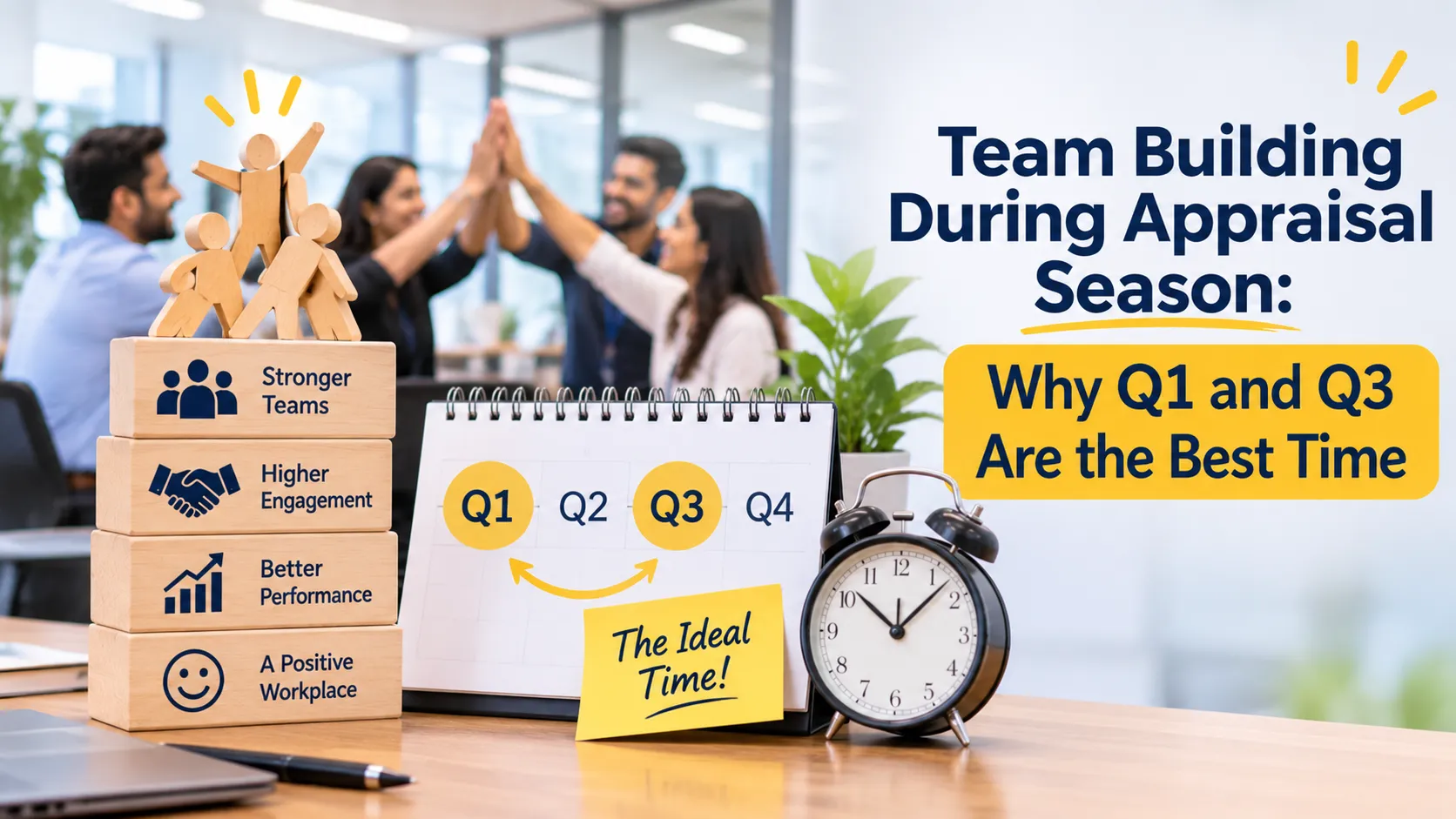
Employees may find themselves mixed with anticipation, pressure as well as uncertainty during the appraisal season. Issues of performance discussion, targets, feedback, and compensation can influence team morale and workplace relations. Team building is used frequently to enable companies to keep employees engaged and have a supportive working environment in such times. Q1 and Q3 are special periods to schedule team building as it might assist teams to expand following goal setting and reconnect prior to the latter segments of the business year.
One of the key stages in the lifecycle of employees is the appraisal season. Performance reviews provide employees and managers with a chance to discuss performance, challenges, goals, and plans of development.
Nonetheless, there is also a chance that workplace pressure increases because of appraisal periods. Staff can fear performance evaluation, salary increases, or prestige, or have concerns about what lies ahead. Managers can also be experiencing higher workloads preparing and conducting reviews.
This makes team building during appraisal season particularly valuable. Instead of treating team building as an occasional recreational event, companies can use it as part of their broader employee engagement strategy.
Activities can even be made more effective by planning them at the appropriate time of the business year. Two time frames were Q1 and Q3, where team building could be useful in offering support to team morale and team teamwork.
Importance of Quarterly Team Building Activities
Team building need not necessarily take place once a year. Quarterly activities provide the companies with frequent possibilities to close the workplace relationships and keep employees engaged.
Consistent team building can help employees:
The quarterly activities also enable companies to adjust activities based on the requirements of the team at that time.
Why Q1 and Q3 Are the Best Time for Team Building Activities
Q1: Build Connections Around New Goals
New targets, projects, responsibilities, and priorities have a way of coming out in the first quarter. This presents Q1 as an ideal time for companies to arrange events that enable workers to learn about each other and build stronger working relationships.
A business can also arrange team-building problem-solving tasks or business simulations, strategy games, and team-based planning. The purpose is not merely to be entertained. These activities may assist the employees in feeling more comfortable working together as they embark on a new business cycle.
By Q3, workers can potentially have spent months trying to achieve yearly goals.There may be an increase in workloads, tightening of deadlines and employees may start to feel fatigued.
Team building An activity organized in Q3 will enable teams to take a break in their daily work. It can also offer managers a chance to see improvement prior to the last quarter.
Team building before performance reviews can give employees an opportunity to reconnect with colleagues outside the formal evaluation process. Prior to performance reviews, firms can arrange low-pressure teamwork exercises instead of competitions.
It should be concentrated on contact and communication with other employees, assisting employees communicate with others beyond targets and assessments.
Top Virtual Team Building Activities for Remote Teams
Appraisal-season involvement programs should also include remote workers. Businesses need not have complex technologies to arrange virtual events and get the employees to work together. It can be one of the following:
The options of indoor and outdoor are available to companies based on their employees, location, time frame, and goals.
Indoor Team Building
Indoor activities come in handy in cases where firms need more control of the environment and timing.
Options can include:
Companies looking for professional support can work with a Corporate Team Building Company to plan activities based on team size and objectives.
Field trips may not only give employees a different scenery, but it will also get them out of their normal work area and get them to socialize too. Companies can organize structured activities such as team challenges, corporate treasure hunts, relay-based collaboration tasks, or outdoor strategy games.
Nevertheless, outdoor activities must be inclusive. Teamwork should be considered, not physical ability.Companies can also explore In Person Team Building Activities when they want employees to interact face-to-face during the appraisal cycle.
During performance reviews, stress experienced may arise during the period of time when employees are already going through a heavy workload. The team-building process can also be a regulated time to ditch daily routine duties and bond with colleagues.
Team building should not be a substitute to dealing with heavy workloads or work stress within the company. Rather, it must be a supplement to overall efforts at employee well-being.
Organizations can explore strategies for fighting employee burnout through team building while designing activities around employee needs.
Performance reviews are not the end of employee engagement. Positive workplace relationships and chances to socialize beyond the daily duties of the employees make them feel affiliated with an organization. Team building can therefore be embedded in a broader retention strategy.
Companies interested in strengthening long-term engagement can explore how team building should be part of your employee retention strategy. Consistency is the key. One set of annual events will not have the same impact it could have with smaller, planned events over the year.
Office-based activities can be particularly useful during Q1 and Q3 because they require less logistical planning than large off-site events.
Companies can organize:
For more ideas, companies can explore fun employee engagement activities in the office and select options that fit their employees and workplace culture.
For companies in India, these activities can also support employee engagement during appraisal cycle in India by giving employees opportunities to connect and collaborate beyond formal performance conversations.
Performance ratings, targets, and difficult conversations should not necessarily define appraisal season. Team building can assist companies to stay connected and maintain morale as long as the process is planned well during the appraisal cycle.
Q1 will help to establish the relationship based on new goals, whereas Q3 will give the possibility of re-energizing the employees prior to the ultimate business run. The best idea is to select the activities which possess clear purpose, involve various kinds of employees and provide the possibilities of real cooperation.
When team building becomes a constant part of company culture rather than an annual event, it can lead to closer relationships, increased participation, and a more cohesive workplace.
What is so good about Q1 as the time of team building?
Q1 is usually the start of new business objectives and initiatives. Team building will assist employees in establishing relationships and working well together since the new performance cycle starts.
What is the reason why we should hold team building in Q3?
Q3 may be a stressful season with staff moving towards hitting goals. To renew team morale and enhance teamwork ahead of the final quarter, a team-building exercise could help.
Is team building to be conducted prior to performance review?
It can. Pre-review patient and cooperative activities with low pressure can be used to help employees maintain good working relationships in the workplace. Nevertheless, team building must not be employed to affect or substitute objective performance evaluations.
Will team building contribute to employee burnouts?
Team building may help to give employees a refreshing dose of not doing regular work and may promote social bonding, but cannot endanger employee well-being and effective workload management.