

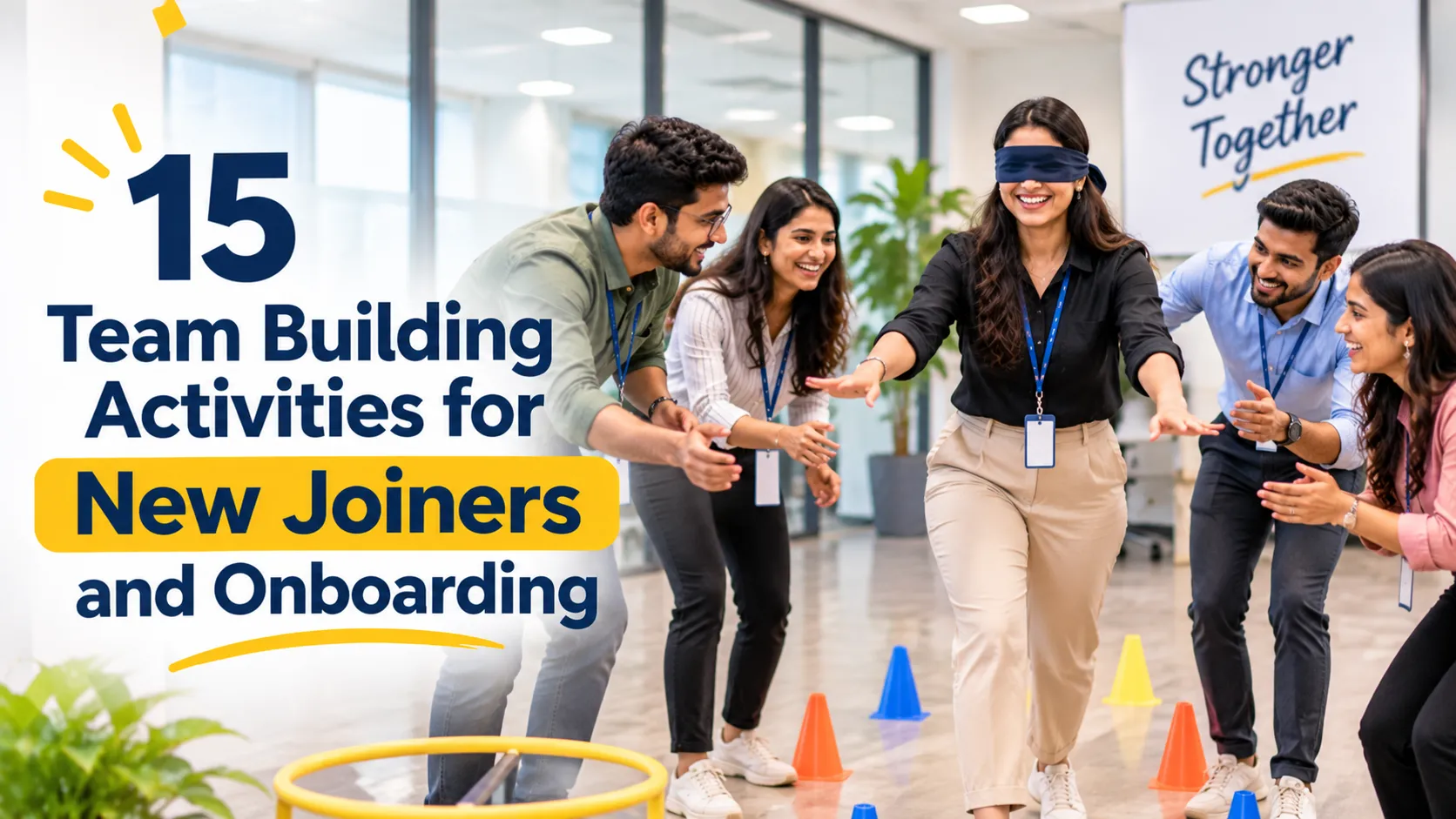
The new organization is exciting, and at the same time, it may be intimidating. The new employees have to understand the culture of the company, learn to recognize other employees, new processes and learn to deal with a new environment at the workplace. This transition can be facilitated through well coordinated team building activities for new joiners, since such activities will allow employees to interact, communicate and work together.
The onboarding of new hires needs to be a part of the training and orientation sessions to organizations and HR teams in India. The interactive corporate activities may assist the new employees to develop relationships with their workmates as they get familiar with the working style of the organization.
The guide covers 15 effective onboarding team-building activities that companies can embrace to make the process of new-hire integration more interactive and participative.
The initial weeks may affect the speed at which a new employee feels at ease in an organization. Formal onboarding is very useful in acquainting employees with their role, policies, systems, and responsibilities but informal interaction is equally important.
A new worker might personally learn about their manager, team, but have very little contact with the other departments. This may complicate the building of work relationships. This is where team building activities for new joiners can make onboarding more interactive.
Team building in the corporate level provides the new workers with the opportunity to interact with other workers who are not part of their routine work duties. They can also make the employees collaborate on a common goal as opposed to merely meeting each other with the traditional icebreakers.
For companies looking for face-to-face formats, In-Person Team Building Activities can provide ideas for structured activities that encourage direct interaction.
Gen Z employees are increasingly becoming a reality in workplaces in any industry in India. Matters that have been embraced by many include digital communication, technology-based teamwork, and fast access to information.
Nevertheless, getting to know Gen Z employees cannot imply believing that all young employees share certain preferences. Individuals have different communication styles, personas, interests, and expectations.
In the case of organizations, they are supposed to be striving towards creating an inclusive working environment in which new workers can feel comfortable being involved.
This can be facilitated through interactive activities which give various means of employee contribution. Others can simply monopolize the discussion; of course, there are those who excel at being clever, organizing, and solving puzzles, or simply applauding their uncultured mates.
New employees often need time to understand how colleagues communicate and collaborate. Team-building activities can accelerate this process by creating shared experiences.
A structured activity gives new employees a natural reason to speak with colleagues instead of relying on spontaneous conversations.
New hires can interact with people from departments they may not regularly work with. This can help them understand the wider organisation.
Interactive activities can provide a change from presentations, policy sessions, and training modules.
When employees have to complete a shared challenge, they learn how different colleagues communicate, make decisions, and contribute.
A successful team activity can give new employees a positive shared experience with their colleagues, helping them feel more connected to the organization.
Develop a team-based competition based on the values, history, products, or milestones of the organization. A team is able to solve clues, answer questions or complete jobs related to the company. It ushers new workers in to the organization and promotes teamwork.
A corporate treasure hunt can combine clues, puzzles, movement, and teamwork. Teams work together to complete a sequence of challenges. The clues can incorporate company information, workplace locations, or organizational values. This is one of the engaging new hire integration activities for bringing new employees and existing employees together.
Give each team a hypothetical mission in which members must create, communicate, and execute a solution. The different members can be responsible for various sections of the task which will prompt the employees to find out each other’s strengths.
Teams receive a list of tasks or clues connected to the workplace. The activity encourages new employees to explore their surroundings while interacting with colleagues. For additional ideas, see 20 office game ideas to strengthen team bonding.
Provide groups with a set of resources and a particular task. They have to develop and design a framework or model within a limited period of time. The exercise promotes planning, creativity, delegation, and communication.
In this activity, information must be passed on between participants until a task is accomplished by the team. It shows the impact of being clear, listening and sharing the right information on teamwork.
The teams will solve a series of puzzles necessitating observation, logical reasoning, communication, and cooperation. As various puzzles may involve different skills, participants will be given several chances to play.
Create a business problem that is fictitious and give it to teams to create an innovative solution. The participants are then able to share their ideas with the rest of the group. This format may be tailored to the industry, company products, customers or issues of the company workplace. Companies looking for additional workplace ideas can explore fun employee engagement activities in the office.
The new employees are separated into teams and asked to form a team name, team logo, team identity and brief presentation. The game promotes creativity and also allows the players to familiarize themselves with each other.
A corporate quiz can combine company-related questions with general knowledge and team-based challenges. Questions can cover company history, products, values, workplace culture, or fun facts. You can adapt the format for both small and large onboarding groups.
Give teams a fictional workplace problem and ask them to develop a solution within a defined time. The exercise encourages participants to listen to different viewpoints and reach a collective decision.
Teams receive a scenario where they must allocate limited resources, prioritise tasks, and make strategic decisions. This can be particularly useful when onboarding employees into roles that require planning and collaboration.
Teams can be asked to create a short advertisement, campaign concept, product pitch, or presentation. The activity encourages employees to communicate ideas while working with colleagues they may not know well.
A mega challenge could be used as an indoor event, comprising a few short-term events such as puzzles, communication exercises, creative exercises, team games. It is also an effective format to use to conduct office onboarding since it can be organised in a non-outdoor setting. See indoor team building activities for additional ideas.
Compose a special program during which new recruits collaborate on a number of short tasks. The program may consist of company trivia, communication activities, creative activities, problem-solving activities, and team missions.
This provides a structured introduction and assists the new employees in establishing connections with other employees throughout the organization. In the case of smaller onboarding groups, another option that companies can consider is team building activities for small groups, which offers a flexible format.
Onboarding is more than just getting people familiar with the rules and procedures. The newly hired personnel also require chances to develop relationships and note how their peers who work with them get along.
The right team building activities for new joiners can make this process more interactive. Companies can create meaningful onboarding experiences in a variety of different ways; it can be corporate treasure hunts and puzzle challenges or creation of innovation exercises and team missions.
Organizations need to take into account the profile of employees, size of group, venue, the company culture and the intended outcomes when planning team building when the new employees are based in India. The activities should be all-inclusive and designed in a manner that everyone has a chance of taking part.
In the proper direction, onboarding team building activities can assist new recruits to transition from being a new employee in an organization to a full-fledged member of a team.
Team building activities for new joiners are structured corporate activities designed to help newly hired employees interact, communicate, collaborate, and become comfortable with their colleagues.
Corporate treasure hunts, communication challenges, corporate quizzes, puzzle challenges, innovation activities, strategy games, and creative team challenges can all be used as onboarding team-building activities.
New hire integration activities can give new employees opportunities to interact with colleagues outside their immediate teams. They can also create shared experiences that support workplace connection and collaboration.
Yes. Interactive corporate activities can provide varied ways for employees to participate. However, activities should be selected based on the actual employee group rather than assumptions about a particular generation.
Yes. Many team building for new employees India programmes can be conducted indoors using puzzles, communication challenges, quizzes, creative activities, and strategy games.
How many activities should be included in an onboarding programme?
The number depends on the available time and group size. A short onboarding session may use two or three activities, while a longer programme can combine several challenges into a structured team-building experience.
Yes. Corporate activities can be customised around company values, products, workplace culture, business themes, group size, and onboarding objectives.