

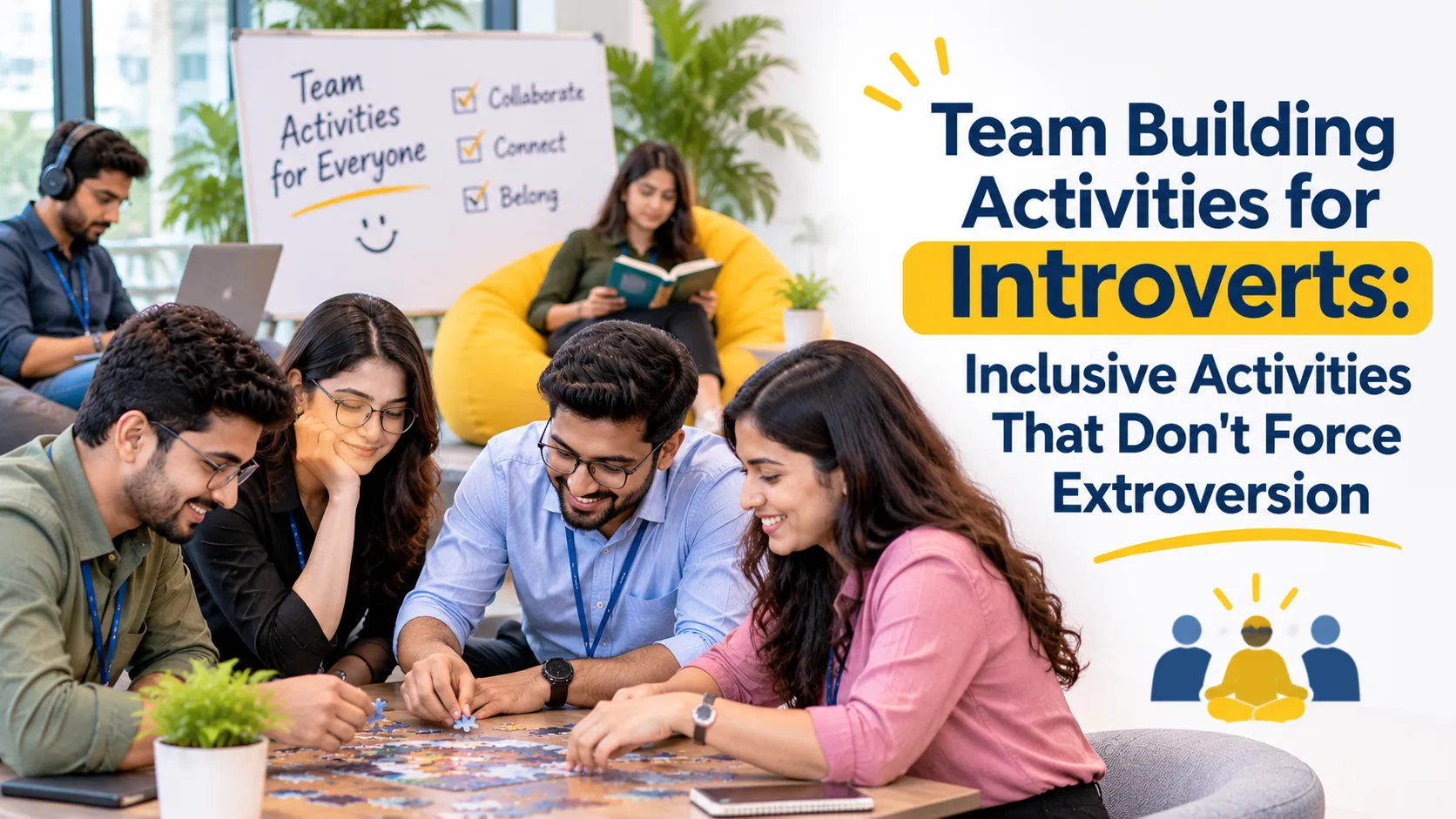
Team building ought to be closer to the employees without leaving any feeling of uneasiness or feeling pressurized by wanting to be very social. For introverted and shy employees, you can offer meaningful events that help them cooperate, interact, and build confidence in each other through well-organized, low-pressure activities. Companies have the choice of undertaking inclusionary team-building activities where staff members may be encouraged to resolve issues, be creative, plan, and interact in small groups rather than force them to perform unwillingly in front of others.
Team building forms a significant aspect of building stronger relationships at the workplace. Nevertheless, old-fashioned corporate events are often based largely on loud games, oratory, competitive games, or those that demand socialization of the employees at all times.
Such formats are probably entertaining to certain employees, but embarrassing to an introverted or shy team member.
Being introverted does not imply that an employee does not desire to be involved. Most employees who are introverts like working together when they have a purpose, time to think and when they are comfortable.
That is why companies should choose team-building activities for introverts that encourage genuine interaction without forcing employees outside their comfort zones.
Employees of different companies possess different personalities and communication styles. Some people just have a natural character where they feel more at ease when talking to a group of people and others where they would like to plan, write and solve problems or conduct a one-on-one conversation.
In cases where the type of activities performed during team building simply promote high outgoing behavior then the silent employees might wind up participating less or sidelined.
Inclusive team building can help companies:
The objective is not to make introverted employees more extroverted. Instead, companies should create activities where different personality types can contribute naturally.
Assign small groups a business challenge that is realistic and direct them to come up with a solution.
In particular, staff might be tasked with enhancing a made-up customer experience, reengineering a business workflow, or resolving a work-related communication problem.
This form of activity provides the introvert employees a chance to make contributions without involving them to work in isolation.
A team-building game based on an escape-room can foster collaboration by having a unified goal.
Staff members collaborate to get hints, gather facts, and find the solutions. Because various operations can be shared out between members of the team, the employees will be able to work with their strengths.
It is also possible that companies develop product, service, value-based or work culture-based challenges.
Strategy-based activities are useful for employees who prefer thoughtful participation.
A fictional business scenario may be provided to teams and they may be told to decide on resources, customers, marketing or operations.
The planning, analysis and collaboration are rewarded in the activity, rather than the fastest speaker.
Traditional trivia can sometimes become uncomfortable when employees have to shout answers in front of everyone.
A more inclusive format is to divide employees into small teams and let them discuss answers before submitting them in writing.
Questions can focus on company history, industry knowledge, products, workplace milestones, or general topics.
Provide creative assignments like creating a mock product, a fictional marketing campaign, or an idea to make the place of work better.
The creative problems can be tackled by the employees in various ways. The ideas might be generated, arranged, and made into the final presentation by one, two, and three separate individuals, respectively.
Part of a scavenger hunt inside the office would motivate the employees to talk and interact without having anyone in the limelight.
Stick to the clues based on collaboration and business-related issues as opposed to embarrassing staff and making them do awkward tasks.
Companies looking for comfortable options can explore these indoor team building activities that can be adapted for different personality types.
Companies also have more control of the environment through indoor activities. Teams are allowed to remain small, they can be instructed very easily and employees can shift/change activities at their own speed.
Some suitable options include:
The important factor is not simply choosing an indoor activity. The activity should also provide employees with clear expectations and different ways to participate.
The companies ought to define what they expect the event to accomplish first. The idea might be to enhance communication, build better relationships, facilitate collaboration, induct new personnel or just provide a means by which other workers can get to know one another.
If you are organizing a corporate event, this guide on how to plan the perfect team building event can help structure the planning process.
When planning an inclusive event, consider:
Consider the size of the team, the preferences of employees, and which manner of interaction to which employees feel comfortable.
Employees who dislike uncertain social situations can be made to participate more easily by having clear instructions and set objectives.
One can de-pressurize a large team by dividing it into sub-teams to have more purposeful discussions.
Not all are required to be the spokesperson. Employees may assist by researching, planning, writing, designing, organizing, or presenting.
Team building becomes more effective when employees feel that they are participating in something meaningful rather than completing an obligatory workplace exercise.
Companies can find more ideas through these team building activities that don’t feel forced.
Activities tend to feel more natural when they have:
Companies should avoid activities where employees are unexpectedly asked to sing, perform, reveal personal information, or become the center of attention. The goal should be connection—not discomfort.
Other employees find it easy to speak and some like to write, plan, analyze or organize. Provide employees with various options of contribution.
All activities do not require a separate presentation. In case in case of presentation, encourage employees to make presentations as a team as opposed to individuals.
Premeditated provision of instructions will give the employees time to comprehend what will occur and be mentally ready.
Team building works best when employees feel comfortable expressing ideas and participating without fear of embarrassment or judgment.
This is closely connected to psychological safety at work. Psychological safety means employees should feel able to ask questions, share ideas, disagree respectfully, and contribute without worrying that they will be ridiculed.
Companies can reinforce this during team building by:
A single team building event cannot create psychological safety by itself, but it can support the culture that companies want to build every day.
For smaller teams, companies can choose activities that allow deeper interaction without creating the pressure of a large group.
These team building activities for small groups can be adapted for introverted employees as well. Nine practical options include:
Small groups also make it easier for managers to ensure that every employee gets an opportunity to contribute without forcing anyone to speak unnecessarily.
Inclusive team building is not regarding the establishment of totally different activities of the introverted employees. It entails coming up with improved company experiences that are sensitive to various personalities.
The most effective activities provide employees with a common purpose, organization and various possibilities to participate.
A firm does not have to provide employees with a boost of volume, extroversion and toughness to create better teams. Everyone has a chance to contribute value when he or she is able to make a contribution either in form of strategy, creativity, problem-solving, communication, or planning.
Ultimately, successful team building should help employees feel connected—not pressured.
Strategic puzzles, pair or group puzzles, company trivia, crafting projects, and case studies, exit games, and knowledge-sharing activities are some good ideas since they do not focus on individual performance.
Bigger groups can be utilized by companies; the instructions should be delivered beforehand, they should not be compelled to talk in front of the audience, and the employees should be offered alternative options to make their contribution.
Companies must be aware of their actions regarding compelled personal sharing, confronting challenges, and surprise acts or placing individual workers in the spotlight.
Indoor activities are not automatically better, but they allow companies to control group size, noise, timing, and the overall environment more easily.
When employees feel safe sharing ideas and communicating without fear of judgment, they are more likely to participate genuinely and collaborate with their colleagues.