

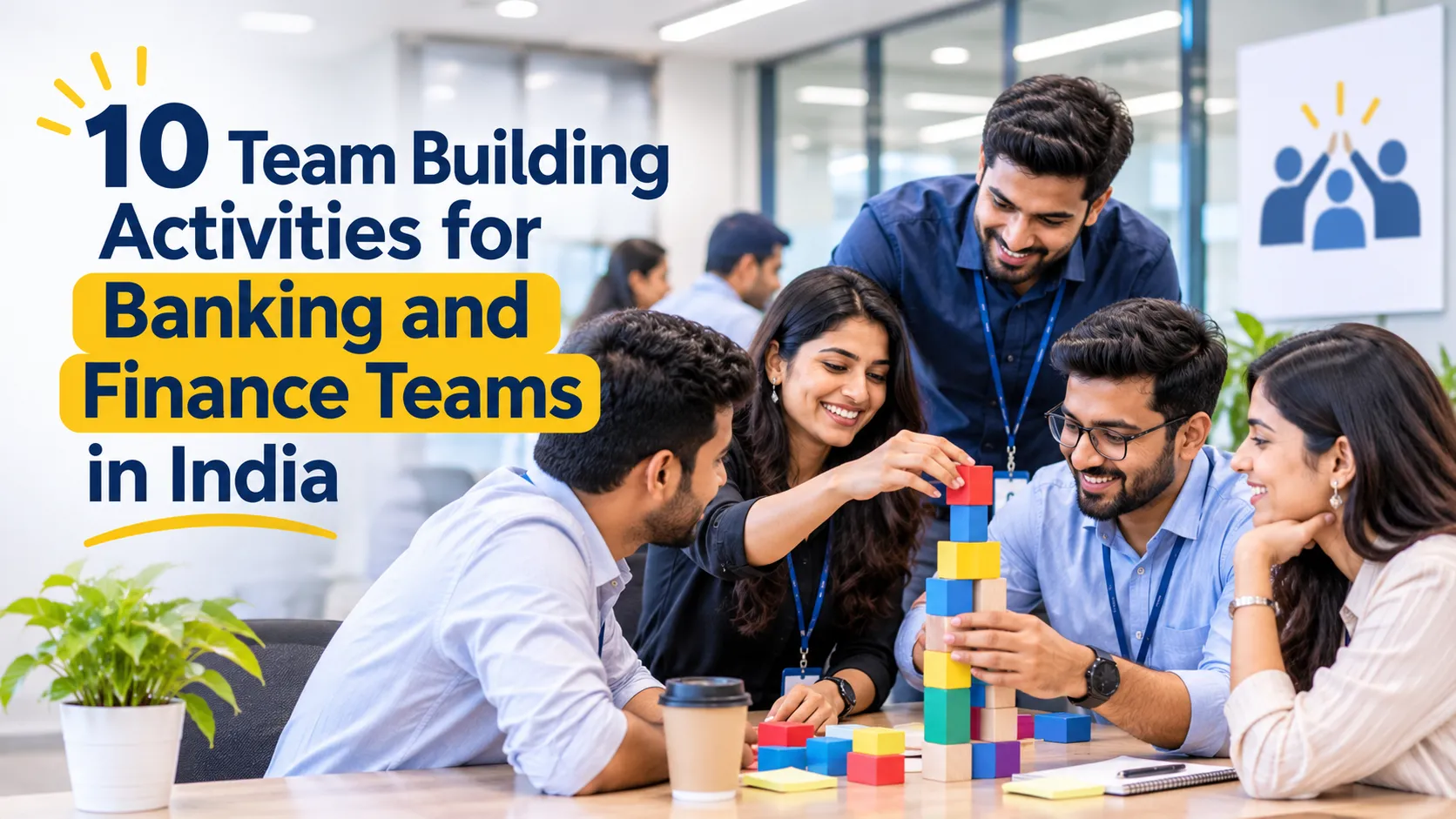
The banking and finance teams operate in a field where precision, teamwork, communication, trust, and promptness of decisions are crucial. Certain team-building activities for finance teams can assist the workers in fortifying these abilities and generate a more engaging working setting.
Team-building programs may be planned on problem-solving, communication, strategy, creativity, and collaboration in case of banks, NBFCs, fintech companies, insurance companies, and other BFSI organizations. Employees also get a chance to mingle with other employees, who they might not have interacted with due to their departments and duties being in different areas.
This guide covers 10 practical activities that companies can use for team building for banking teams, along with tips for selecting a suitable corporate team-building partner in India.
Banks and finance staffs tend to work under stressful situations. The employees might be required to meet deadlines, handle customers, coordinate with different departments, be accurate, and react swiftly to the requirements of changing businesses.
This is why collaboration is especially crucial. A relationship manager can also need to liaise with credit, operations, compliance, and risk teams. Likewise, the finance professionals can collaborate with sales, procurement, technology and leadership teams to accomplish a typical business purpose.
It is in this context that team-building activities, which should be designed especially for finance teams, can be valuable.
This is not just about having a fun day out of the office. An effective program will ensure employees learn skills like communication, leadership, listening, problem-solving, delegation, and teamwork, which they tend to exercise normally in the workplace.
Corporate-compass companies like that organize corporate team-building experiences that can be tailored to the needs of various organizational groups and businesses.
Banking and finance organisations depend heavily on collaboration. Even when employees have specialised responsibilities, their work often connects to the work of other teams.
Activities that are based on communication help employees listen attentively, articulate their concepts and perceive other points of view. They are applicable team skills in functionalally coordinated teams.
A team-building activity will unite employees at various departments. One of the ways to make colleagues learn the working styles and strengths of one another is to work towards a common goal.
There are lots of corporate activities when the participants need to analyse the information, discover the patterns, opinions and solutions within a short period of time. These experiences may offer other forum in practising problem-solving.
Team activities can reveal how employees communicate, organise work, take initiative, manage uncertainty, and support their colleagues. For more on this aspect, see How Corporate Team Building Activities Reveal High Potential Employees.
Financial strategy simulation may put employees in a simulated business situation where teams are required to distribute resources, evaluate risks and risks, and address the evolving situations.
Instead of administering technical financial knowledge, the activity can be based on cooperation and decision-making that can be played by the participants as a whole.
It may be very effective with banking, investment, insurance and finance teams since the scenario is customiseable to business situations.
Split the team into small groups and assign teams a hypothetical business challenge. The teams are to discuss the situation, find out the central issue, and come up with a solution and introduce their idea.
The exercise stimulates thinking and allows various team members to make a proposal.It may also be applicable to mixed groups of employees from finance, operations, sales, HR, technology, and other functions.
Corporate treasure hunt incorporates movement, clues, communication and problem-solving. The teams are provided with a set of tasks, which they need to complete collectively and then arrive at the ultimate goal.
In the case of banking and finance teams, themes which could be used as clues, include numbers, business terminology, logic, patterns, or fictional financial situations.
The treasure hunt can be done indoors as well, and therefore it fits well in offices, hotels, conference rooms and corporate event spaces.
An escape-room-style team challenge requires participants to solve a sequence of puzzles within a fixed time.
Success usually depends on sharing information, listening to colleagues, dividing responsibilities, and combining different ideas.
This makes it a useful option for team building activities for finance teams, particularly when the objective is to encourage collaboration and communication in a high-energy setting.
During a bridge-building exercise, teams are allocated a given set of materials and a prescribed task. They should design, assign work, construct the building and provide tests on the outcome.
The exercise may illustrate how planning and implementation collaborate.
It also allow employees a chance to watch various solutions to the same issue. Few of them might be pre-emphasized planning oriented participants, whereas others might have an orientation towards the implementation or quality control..
Communication games can be designed around information transfer. One participant may receive information that has to be explained to another person, while the rest of the team works towards completing a task.
The challenge can highlight the importance of clarity, active listening, questioning, and confirmation.
These are relevant skills for banking teams where instructions, customer requirements, operational information, and internal communication often pass between multiple people.
Companies looking specifically for In Person Team Building Activities can explore formats that encourage direct interaction between participants.
An innovation challenge asks teams to develop a new product, service, campaign, process, or customer experience.
For a finance organisation, the brief could be something such as creating a fictional banking service for a particular customer segment.
Participants can then develop their concept, define its benefits, create a presentation, and pitch it to a panel.
The activity encourages creativity while requiring teams to collaborate and turn an idea into a structured proposal.
A team relay can combine physical and mental challenges. Instead of relying purely on athletic ability, different stages can require participants to solve puzzles, complete communication tasks, remember information, or work together to achieve a goal.
This makes the activity accessible to employees with different strengths.
For companies searching for additional ideas, 25 Fun Games for Corporate Events provides examples of games that can be adapted for corporate groups.
Designing projects may include a team logo, short ad, generating a campaign concept, constructing a themed model, or short performance.
Even though these activities might be less apparent as related to finance, they can motivate workers to leave their habitual roles and work more in new forms.
Even more engaging involvement in a team can provide other methods to add value by quieter employees.
A corporate mega challenge combines several activities into one programme. Teams may move through different stations involving strategy, communication, creativity, puzzles, and physical challenges.
Points can be awarded at each stage, creating a common objective throughout the event.
This format works particularly well for large banking and BFSI groups because participants can be divided into smaller teams while still taking part in one overall programme.
For organisations looking for a professional partner, Corporate Compass’s Corporate Team Building Company page provides more information about corporate team-building programmes.
Choosing a provider for corporate team building for banks India requires more than selecting a list of games. The programme should match the organisation’s group size, objectives, venue, employee demographics, and available time.
Consider the following factors:
First identify what the organisation wants from the programme. Is the priority communication, collaboration, leadership, employee engagement, cross-functional interaction, or simply creating a shared experience?
An activity that works for 15 employees may not work in the same format for 300 participants. Ask the provider how activities will be facilitated for the expected number of employees.
Finance and BFSI organisations may prefer activities that reflect their workplace environment. Ask whether challenges can be customised around business themes, company values, or specific learning objectives.
Some activities require an open outdoor space, while others can be conducted indoors. If the event is being held at an office or hotel, choose activities that suit the available space.
You can also explore Team Building Activities in Mumbai if you are planning an event in Mumbai.
Well-designed team building activities for finance teams can provide banking and financial-services employees with opportunities to collaborate in ways that differ from their everyday work.
Strategy simulation and business games, treasure hunts, communication games, creative games, and corporate mega games are just some of the formats that companies may play.
The best program is a program that links the activity with any distinct purpose that is interesting to the employees. With an appropriate selection of activities and a good partner in corporate team-building, financial organizations are able to make an experience that integrates participation, collaboration and learning.
The options that would be suitable are strategy simulation, corporate treasure hunt, escape-room, challenge, bridge-building, communication games, innovation challenge, and multi-stage corporate challenge. The appropriate decision will be based on the size of the group, goals, location, and time.
Team building for banking teams can create opportunities for employees to practise communication, collaboration, problem-solving, leadership, and decision-making outside their normal work environment.
Yes. Team building for BFSI can be designed for banks, NBFCs, insurance companies, fintech organisations, investment firms, and other financial-services businesses.
Yes. Many activities can be adapted for offices, hotels, conference rooms, and other indoor venues. Indoor options include communication challenges, strategy games, puzzles, business simulations, creative challenges, and escape-room-style activities.